When you start talking about the different aspects of cars, there are a lot of numbers and figures involved. One such figure that some people might not know about is the number of spark plugs in a V6 engine. This might seem like a small detail, but it can actually have a big impact on how your V6 engine performs.
In this post, we’ll cover how many spark plugs are typically found in a V6 engine, the rare exception worth knowing about, and how to tell when yours actually need replacing.
How Many Spark Plugs Are in a V6 Engine?
The answer is six, as the name suggests. Each cylinder in the V6 engine has its own spark plug, so there are six in total (this is different from a diesel V6, since diesel engines don’t use spark plugs at all). Spark plugs are a vital part of any gasoline engine, as they provide the spark that ignites the fuel and air mixture in the combustion chamber, connected via the ignition coils. Without spark plugs, a gasoline engine won’t start.
Spark plug condition matters for performance, not the count. Worn or fouled spark plugs can cause a misfire in that cylinder, leading to rough running, poor fuel economy, and reduced power. Since a V6 needs all six cylinders firing correctly and in the right sequence, even one bad spark plug can throw off how smoothly the engine runs.
The Twin-Spark Exception: When a V6 Has 12 Spark Plugs
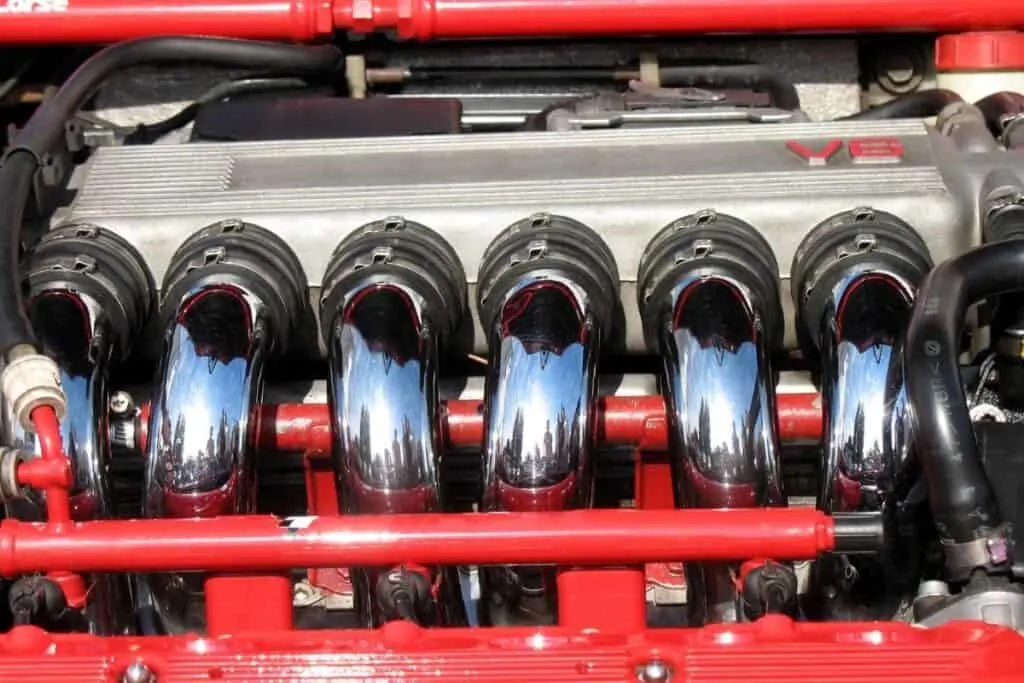
There’s one real exception worth knowing about: a small number of V6 engines use a “twin spark” ignition system, with two spark plugs per cylinder instead of one, bringing the total to 12 rather than 6. Alfa Romeo, Ford, and Mercedes-Benz have all built twin-spark V6 engines at various points, aiming for more complete combustion, slightly better efficiency, and lower emissions. It never became mainstream, mostly because it roughly doubles the parts and labor cost of a spark plug replacement for a fairly modest benefit, so most modern V6 engines have stuck with one plug per cylinder. If you’re not sure which your car has, your owner’s manual will list it, or you can pop the hood and count the spark plug wires or coil packs.
Choosing the Right Spark Plug Type
Aside from the number of spark plugs, another aspect to consider is the type of spark plug you use. There are various types of spark plugs on the market, with different materials and designs that can affect engine performance. Some spark plugs are designed to last longer, while others are made to provide more power. Copper spark plugs are the most common type and are often used in older vehicles. Platinum and iridium spark plugs are newer and offer better performance, but come at a higher cost.
Signs Your V6’s Spark Plugs Need Replacing
Most spark plugs last somewhere between 30,000 and 100,000 miles depending on the type, but a few warning signs can show up before that mileage if something’s off. Watch for rough idling, hesitation or a noticeable loss of power under acceleration, poor fuel economy, trouble starting, or a check engine light with a misfire code (P0300 for a random misfire, or P0301 through P0306 for a specific cylinder). If your car has started to shake when accelerating, a failing spark plug is one of the cheaper things worth ruling out before looking at anything more expensive.
Replacing all six at once, even if only one is misbehaving, is usually the more cost-effective move, since the rest are typically close behind in wear and it saves on labor if you’re paying a shop to do it.
Conclusion
So, how many spark plugs are in a V6 engine? Six is the answer for the vast majority of V6s, with 12 being the rare exception on twin-spark designs from a handful of manufacturers. Make sure to use the correct number of spark plugs for your specific engine, and keep an eye on the signs above so you can catch a failing one before it costs you more down the line.
With this information, you’ll be well on your way to keeping your V6 engine running smoothly.
Frequently Asked Questions
Yes, a rare exception is the “twin spark” V6, which uses two spark plugs per cylinder for a total of 12. Alfa Romeo, Ford, and Mercedes-Benz have built these at various points, though it never became common due to the added cost and complexity.
Check your owner’s manual, or pop the hood and count the spark plug wires or ignition coils. Six means a standard single-plug-per-cylinder V6; twelve means a twin-spark design.
That cylinder will misfire, which usually shows up as rough idling, reduced power, poor fuel economy, and sometimes a flashing check engine light. The other five cylinders keep running, but overall performance suffers.
Most mechanics recommend it, even if only one is failing, since the others are usually close behind in wear and it saves on labor costs compared to replacing them one at a time.
Not necessarily better overall. Twin-spark systems can offer marginally more complete combustion and lower emissions, but the real-world benefit is modest and comes with roughly double the spark plug replacement cost.