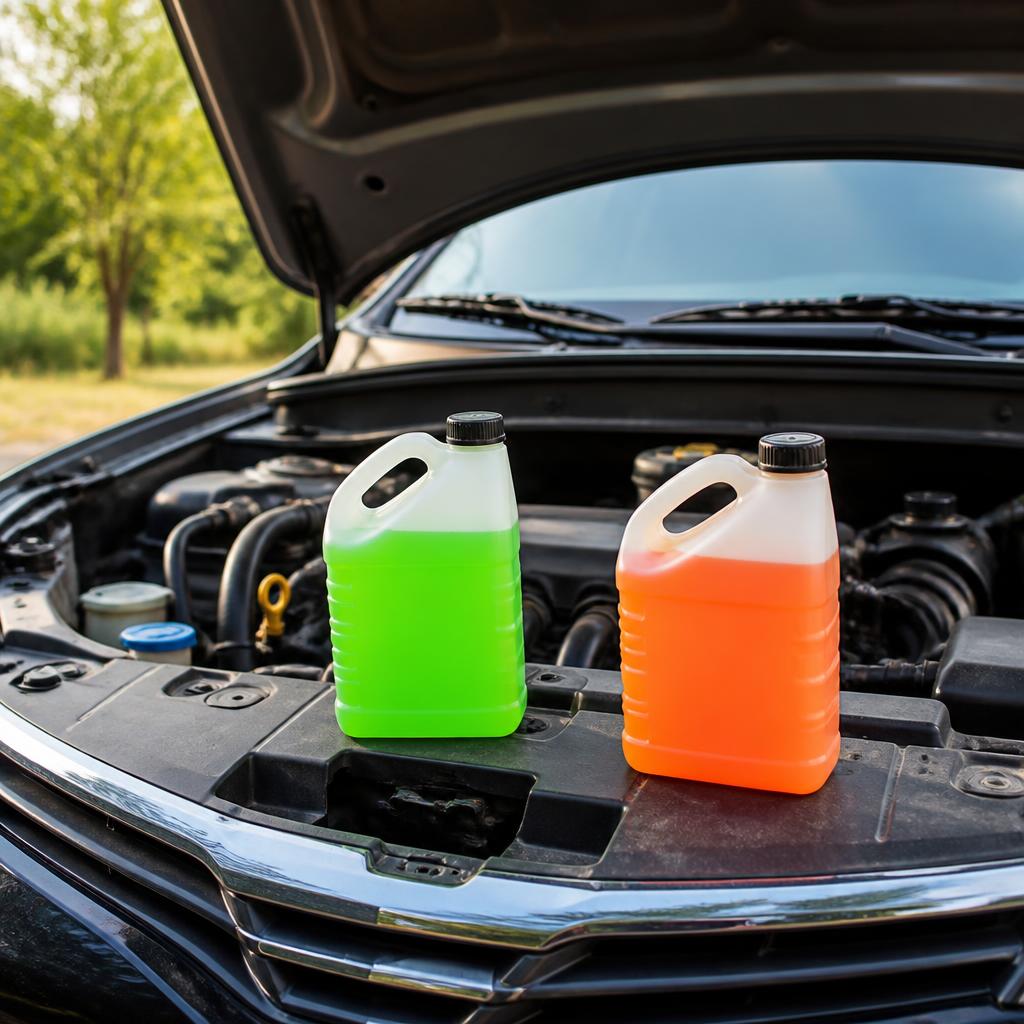
You popped the hood to top off your coolant and realized the reservoir has orange fluid in it, but all you have on hand is green. Or maybe your radiator is bone dry and you’re just grabbing whatever’s cheapest. Either way, the question is the same: can you use green coolant instead of orange? The short answer is no, not without a full flush first, and here’s why that matters more than it might seem.
Why Green and Orange Coolant Aren’t Interchangeable
The color of coolant isn’t just branding. Green coolant is typically IAT, or Inorganic Additive Technology, an older formula that’s been used since the 1960s. Orange coolant is usually OAT, or Organic Acid Technology, a newer formula popularized by GM’s Dex-Cool starting in the 1990s. The two use different corrosion inhibitor chemistries to protect your engine’s metal and rubber components, and those chemistries don’t play well together.
Green coolant typically needs replacing every 2 years or 24,000 to 30,000 miles, since its silicate-based inhibitors deplete relatively quickly. Orange coolant is designed to last much longer, often 5 years or 100,000 to 150,000 miles, thanks to its organic acid inhibitors, which is a different chemistry entirely from something like G12 coolant, a hybrid formula used by several European manufacturers. That difference in lifespan is part of why manufacturers don’t want the two mixed.
Can You Use Green Coolant Instead of Orange? What Happens If You Mix Them
Mixing green and orange coolant doesn’t cause an explosion or anything dramatic under the hood, but it does cause a real problem: the two additive packages can react and form a thick, gel-like sludge inside your cooling system. That sludge can clog narrow passages in the radiator, heater core, and engine block, restricting coolant flow exactly where you need it most. Reduced flow means reduced cooling, which can lead to localized hot spots and, over time, overheating, the same end result you’d face from any other cause covered in our guide on what to do when your car overheats.
Even if you don’t see sludge form right away, mixing the two formulas cancels out some of the corrosion protection each one is designed to provide, leaving your radiator, water pump, and heater core more exposed to rust and corrosion than either coolant alone would allow.
What to Do If You Need to Switch
If you want or need to switch from orange to green, or the other way around, the safe approach is a full cooling system flush, not just a top-off. Drain the old coolant completely, flush the system with clean water or a dedicated flushing solution until it runs clear, and then fill with your new coolant of choice, mixed to the manufacturer’s recommended ratio with distilled water, usually 50/50.
If you’re not sure which type your car currently uses, check your owner’s manual or look for a coolant type sticker under the hood; it’s also worth confirming whether coolant and antifreeze are the same thing in your specific case, since the terms are often used interchangeably. When in doubt, a small top-off of plain water to get you home is safer than guessing wrong with a full bottle of the opposite coolant type.
Universal and Hybrid Coolants
Some manufacturers now sell universal or hybrid coolants marketed as safe to mix with any color or type already in the system, unrelated to whether coolant affects your air conditioning, which is a separate system entirely. These use a different chemistry designed specifically for compatibility, and they can be a convenient option if you’re unsure what’s currently in your radiator. That said, always check the bottle’s labeling to confirm it’s genuinely rated as universal, rather than assuming based on color alone, since color coding isn’t standardized across every brand.
Conclusion
So, can you use green coolant instead of orange? Not by simply topping off the reservoir. The two use different additive chemistries that can react and reduce cooling efficiency when mixed. If you want to switch types, do a full flush first, or stick with a genuine universal coolant if you’re unsure what’s already in your system.
Frequently Asked Questions
Is it OK to top off with water if I only have the wrong coolant color on hand?
Yes, a small amount of plain or distilled water is a safer emergency top-off than mixing coolant chemistries, though you should do a proper flush and refill as soon as possible afterward.
How do I know which coolant type my car already uses?
Check your owner’s manual, look for a coolant specification sticker under the hood, or ask your dealer or a mechanic to check, since the color alone isn’t always a reliable indicator across brands.
What happens if I accidentally mixed green and orange coolant already?
If it was a small amount, monitor for overheating and unusual coolant color or texture, and plan a full flush soon. If you notice sludge, reduced heater performance, or overheating, have it flushed as soon as possible.
Is pink or blue coolant the same as orange or green?
Not necessarily. Pink and blue coolants are used by different manufacturers for their own specific formulas, and color alone doesn’t guarantee compatibility. Always check the coolant type printed on the bottle, not just its color.