
Vibration only at 70 mph is one of the most common complaints drivers bring to tire shops. The car feels smooth around town, then a shimmy appears somewhere between 60 and 75 mph and often fades again at higher speeds. In most cases, the cause is an out-of-balance tire or wheel. Because the vibration builds as the wheel spins faster and peaks at a certain speed, it shows up at highway speeds and not in town.
Why Vibration Appears at One Specific Speed
Every wheel and tire assembly has a natural frequency. When a heavy spot on the tire spins at the right rate, it lines up with the resonant frequency of the suspension and steering, and the shake becomes noticeable. Above or below that speed, the vibration may smooth out. That’s why a balance problem often feels worst at 65 to 75 mph and seems to disappear at 80. For a broader look at vibration at all speeds, see why is my car shaking.
Common Causes of Vibration Only at 70 MPH
1. Unbalanced Tires
This is the number one cause. Wheel weights can fall off after hitting a pothole or curb, and tires wear unevenly over time, changing their balance. If you feel the vibration in the steering wheel, the problem is usually in the front tires. If you feel it in the seat or floor, it’s more likely in the rear. A road-force balance is the best test for stubborn cases.
2. Bent Wheel
A hard pothole impact can bend a wheel slightly, even if it doesn’t look damaged. A bent rim can’t be fully corrected by balancing. Tire shops can check runout on the balancer and tell you if the wheel needs repair or replacement.
3. Out-of-Round or Damaged Tire
A tire with a separated belt, a bulge, flat spots from sitting, or uneven wear can cause a speed-specific vibration. Run your hand over the tread and look for bulges on the sidewall. Uneven wear patterns such as tire feathering also point to alignment or suspension issues behind the vibration. A tire with a separated belt is a safety risk and should be replaced right away.
4. Worn Suspension or Steering Parts
Worn tie rod ends, ball joints, or control arm bushings let the wheel move slightly, which can amplify a minor imbalance at highway speed. If the steering also feels loose, read how long you can drive with a bad tie rod end.
5. Driveline Problems
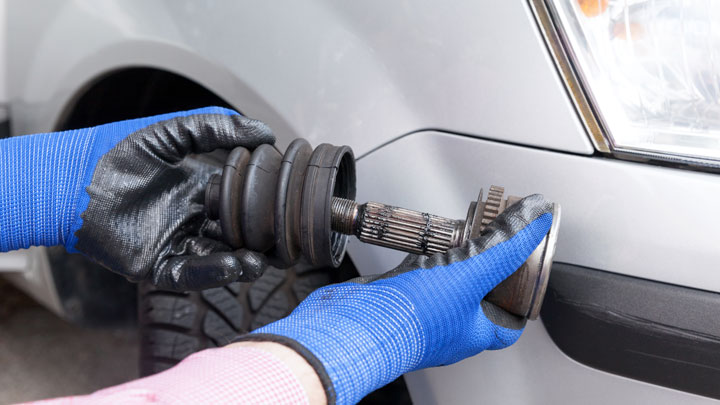
On rear-wheel-drive and four-wheel-drive vehicles, a worn U-joint or an unbalanced driveshaft can cause vibration that builds with speed. On front-wheel-drive cars, a worn inner CV joint can do the same, especially under acceleration. Driveline vibrations are usually felt more in the floor than the steering wheel.
6. Warped Brake Rotors
Uneven rotors mostly cause vibration when braking, but a severely warped rotor or a sticking caliper can create a shimmy at speed too. If the shake gets worse when you press the brake pedal, the brakes are the likely source.
How to Narrow Down the Cause
- Steering wheel shake: front tires, wheels, or steering parts. See why is my steering wheel shaking.
- Seat or floor shake: rear tires, driveshaft, or U-joints.
- Gets worse when braking: rotors or calipers.
- Changes when accelerating or coasting: CV joints or driveline.
- Started after new tires: balance or mounting issue at the shop.
How to Fix It
Start with the cheapest and most likely fix: have all four tires balanced, ideally on a road-force balancer. If the vibration remains, have the wheels checked for bends and the tires checked for damage. Next, inspect suspension and steering parts and get an alignment. If none of that solves it, a shop should check the driveshaft, U-joints, and CV axles. Regular rotations help keep wear even, so follow a schedule for how often to rotate tires.
Conclusion
Vibration only at 70 mph usually comes down to tire balance, a bent wheel, or a damaged tire, with worn suspension or driveline parts as the next suspects. Pay attention to where you feel it and whether braking or accelerating changes it, then start with a balance check. Fixing it early protects your tires, suspension, and steering from extra wear.
Frequently Asked Questions
Why does my car shake at 70 mph but not at 80?
An imbalance often matches the natural frequency of the suspension at a certain speed. Above that speed, the vibration can smooth out, even though the problem is still there.
Is it safe to drive with vibration at highway speed?
A mild balance vibration isn’t usually an emergency, but it should be fixed soon. Severe or sudden shaking, a bulging tire, or loose steering should be checked right away.
Can alignment cause vibration at 70 mph?
Alignment itself rarely causes vibration, but bad alignment causes uneven tire wear, which can lead to vibration. Balancing is usually the first fix to try.
How much does it cost to fix highway vibration?
Balancing four tires typically costs a modest amount at most tire shops. Costs rise if a wheel, tire, or suspension part needs replacement.