Most car owners would agree that the engine is the heart of the car — it’s what generates the power that turns the wheels. Spark plugs play a vital role in that process: they ignite the fuel inside each cylinder’s combustion chamber. If you’re asking how many spark plugs a V4 engine has, the short answer is four — but there’s an important terminology mix-up worth clearing up first, since “V4” and “four-cylinder” don’t always mean the same thing.
In this post, we’ll answer the spark plug question directly, then explain the difference between a true V4 engine and the far more common inline-four (I4), so you know exactly what’s under your hood.
How Many Spark Plugs Are in a V4 Engine?
A V4 engine has four cylinders arranged in two banks of two, set at an angle to form a “V” shape — similar in concept to a V6 or V8, just with fewer cylinders. Like nearly all gasoline engines, a V4 uses one spark plug per cylinder, so a V4 engine has four spark plugs total. Each spark plug sits at the top of its cylinder, connected to the ignition coil and wiring, and fires at the precise moment needed to ignite that cylinder’s air-fuel mixture.
V4 vs. Inline-Four: Which One Do You Actually Have?
Here’s the part that trips a lot of people up: true V4 engines are actually rare in cars. Despite the name sounding like a common four-cylinder layout, V4 engines have only appeared in a handful of production vehicles over the decades — the Ford Taunus V4, the Saab 95/96, and the Lancia Fulvia are some of the better-known examples — and no current production passenger car uses one. V4s are far more common in motorcycles, where brands like Honda and Aprilia still use them today.
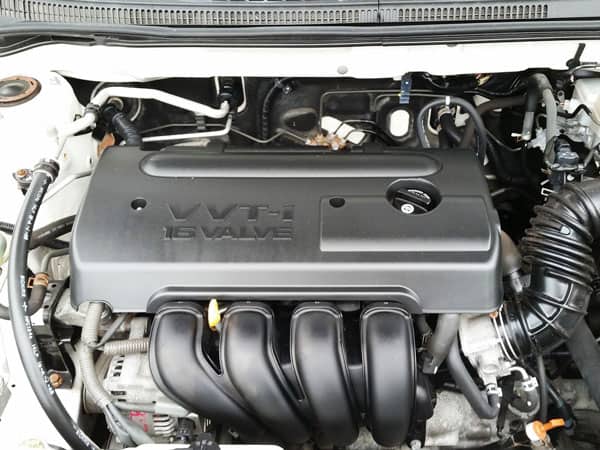
What most people actually have under the hood of a modern small or mid-size car is an inline-four (I4) — four cylinders arranged in a single straight row rather than a V shape. The good news is the spark plug count is exactly the same either way: one per cylinder, four total. So whether your engine is technically a V4 or an inline-four, you can count on needing four spark plugs at replacement time — just double-check your owner’s manual or VIN to confirm the exact spec for your specific engine.
Why Spark Plugs Matter
Spark plugs are essential to smooth engine operation. They ignite the air-fuel mixture inside the combustion chamber — NGK, a leading spark plug manufacturer, has a good breakdown of exactly how this works — and that ignition is what pushes the pistons and generates power. Worn or fouled spark plugs are a common cause of rough idling, poor acceleration, and misfires. If your car has started to shudder or shake when accelerating, worn spark plugs are worth checking early, since they’re one of the cheaper things to rule out. Keeping spark plugs in good condition also helps with fuel efficiency and emissions.
How Long Do Spark Plugs Last?
Spark plug lifespan varies with driving conditions, fuel quality, and plug type, but most last somewhere between 30,000 and 100,000 miles. Standard copper plugs tend to wear out faster, while iridium and platinum plugs are built to last longer. Regular maintenance — inspecting, cleaning, and replacing plugs on the schedule in your owner’s manual — is the simplest way to avoid surprise misfires.
Replacing Spark Plugs in a V4 Engine
Replacing spark plugs in a V4 (or inline-four) engine is a relatively straightforward job. It involves removing the old plugs and installing new ones, gapped and torqued to the manufacturer’s spec. Basic hand tools are usually enough, but it’s worth following your vehicle’s specific instructions, since access to each cylinder can vary by engine layout. If you’d rather not do it yourself — or you’re wondering whether it’s worth replacing your ignition coils along with your spark plugs — it’s worth having a mechanic take a look.
Conclusion
A V4 engine — or, more likely, the inline-four engine actually under your hood — has four cylinders and four spark plugs, one per cylinder. Spark plugs are small parts, but they play an outsized role in how smoothly your engine runs, so keeping them in good shape pays off in performance, fuel economy, and reliability.
Whether you’re replacing plugs yourself or having a mechanic do it, understanding how many you need — and confirming whether your engine is truly a V4 or an inline-four — takes the guesswork out of the job.
Frequently Asked Questions
Not exactly. Both have four cylinders, but a V4 arranges them in a V shape across two banks, while the far more common inline-four (I4) lines all four up in a single row. Spark plug count is the same either way: four.
No mainstream production passenger car currently uses a V4. Historical examples include the Ford Taunus V4, Saab 95/96, and Lancia Fulvia. V4s are still used in some motorcycles today.
Common signs include rough idling, reduced fuel economy, trouble starting, engine misfires, and a noticeable loss of acceleration or shaking under load.
Many DIY-inclined owners can replace spark plugs with basic hand tools and the correct torque spec. If you’re not confident, or your engine layout makes the plugs hard to access, a mechanic is the safer choice.
Yes. Standard copper spark plugs typically need replacing sooner, often around 30,000 miles, while iridium and platinum plugs can last closer to 60,000 to 100,000 miles depending on the manufacturer’s spec.