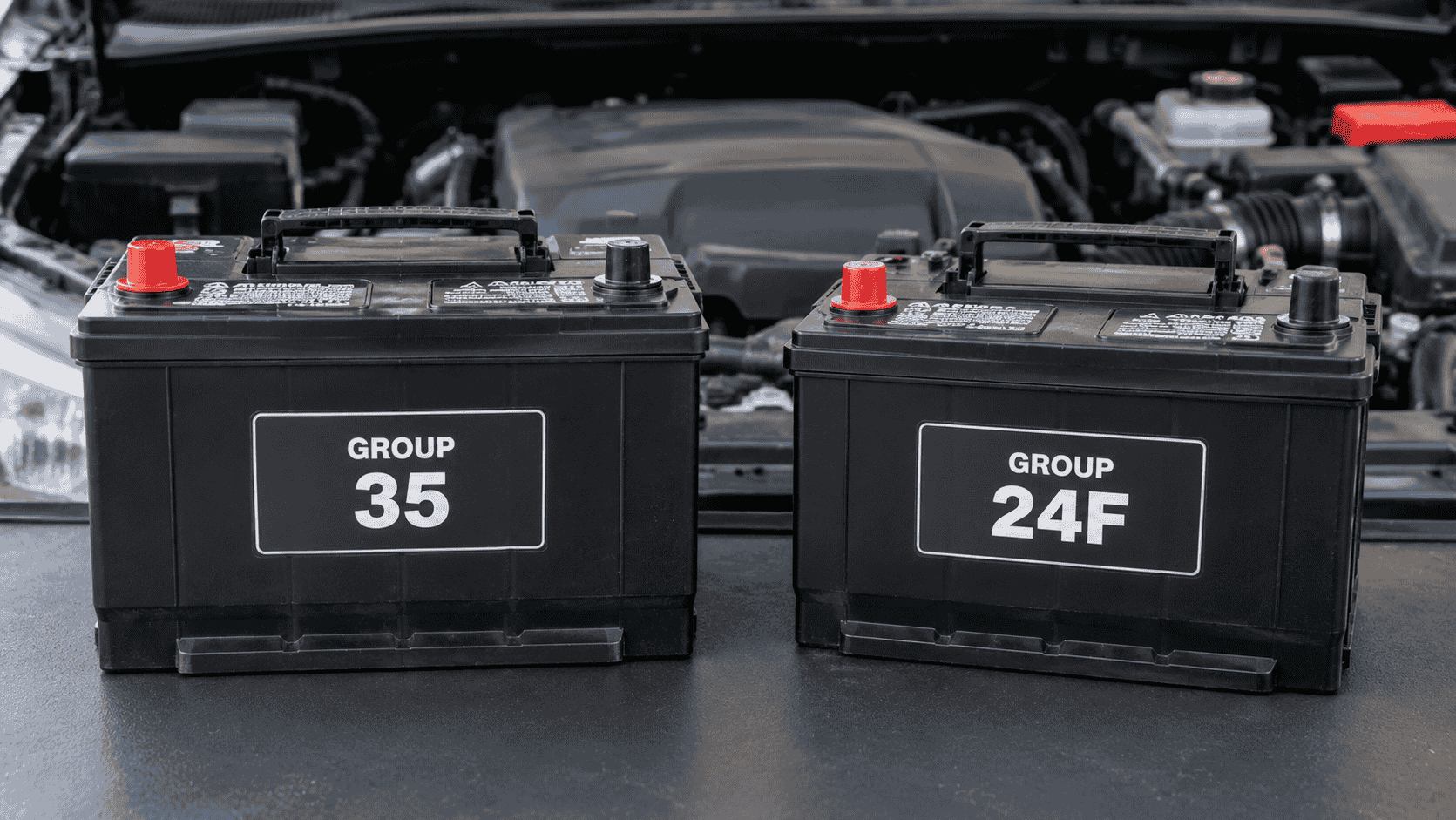
Can I use a group 24F battery instead of 35? Sometimes, but only if it physically fits. A Group 24F is noticeably longer than a Group 35, so it needs a battery tray and hold-down with enough room, and its terminals have to line up so your cables reach the right posts. Many Toyotas, for example, are fitted with either size from the factory depending on trim and market. But in a car built tightly around a Group 35, the 24F simply won’t fit.
Group 24F vs Group 35: The Key Differences
Battery group sizes are set by the Battery Council International (BCI). The group number defines the case dimensions, terminal type, and terminal position. It doesn’t tell you the battery’s power.
| Spec | Group 35 | Group 24F |
|---|---|---|
| Approx. length | 9.1 in | 10.3 to 10.75 in |
| Approx. width | 6.9 in | 6.8 in |
| Approx. height | 8.9 in | 8.9 to 9.0 in |
| Typical use | Many Japanese cars and small SUVs | Larger sedans, SUVs, and minivans |
Published 24F lengths vary a little by manufacturer, but in every case it’s at least an inch longer than a Group 35. That extra length is the main reason the swap does or doesn’t work.
What to Check Before You Swap
- Tray length: measure the battery tray. If it can’t hold a battery about 10.5 inches long, a 24F won’t sit flat.
- Hold-down: the clamp or bracket must secure the battery firmly. A loose battery can shift, short against metal, or crack.
- Terminal layout: compare the positive and negative post positions with your old battery. Your cables must reach without stretching, and the positive cable must never be forced onto the negative post.
- Hood clearance: make sure the terminals won’t touch the hood or any metal when it’s closed.
Because published terminal layouts differ between sources, the safest check is to put the new battery next to your old one, or compare their labels, before you buy.
Is a 24F Better Than a 35?
A 24F’s larger case usually has room for more lead plates, so it often offers a higher cold cranking amp (CCA) rating and reserve capacity than a Group 35 in the same product line. That can help in cold climates or in cars with heavy electrical loads. But a bigger battery isn’t automatically better. What matters is that it fits securely and meets or exceeds the CCA your owner’s manual calls for.
If your current battery keeps dying, the problem may not be the battery size at all. A failing charging system can drain even a new battery, so check whether your alternator is bad before blaming the battery. And if your battery is completely flat, our guide on whether a car battery can be too dead to jump start explains your options.
After Installing the New Battery
Some newer vehicles track battery condition electronically and need to be told a new battery was installed, so the charging system adjusts correctly. Ford is one example, and our guide on how to reset the Ford battery management system walks through it. Also clean the terminals and tighten the clamps, and add a battery check to your regular car maintenance checklist.
Conclusion
So, can I use a group 24F battery instead of 35? Yes, if your tray is long enough, the hold-down secures it, the terminals line up with your cables, and the hood clears the posts. In return, you often get more cranking power. If any of those checks fail, stick with the Group 35 your vehicle was designed for.
Frequently Asked Questions
Can I use a Group 35 battery instead of a 24F?
Sometimes. A Group 35 is shorter, so it may fit a 24F tray, but the hold-down must still clamp it securely and your cables must reach the posts. Make sure its CCA rating meets your vehicle’s requirement.
What does the F in 24F mean?
The letter indicates a variation in terminal placement from the base Group 24 size. Always compare terminal positions with your old battery rather than relying on the letter alone.
Does a bigger battery hurt my car’s alternator?
No. A larger battery with more capacity doesn’t overwork a healthy alternator. The charging system simply tops it up as needed.
How do I know which battery group size my car needs?
Check your owner’s manual, look at the label on your current battery, or use a parts store’s lookup by year, make, model, and engine.