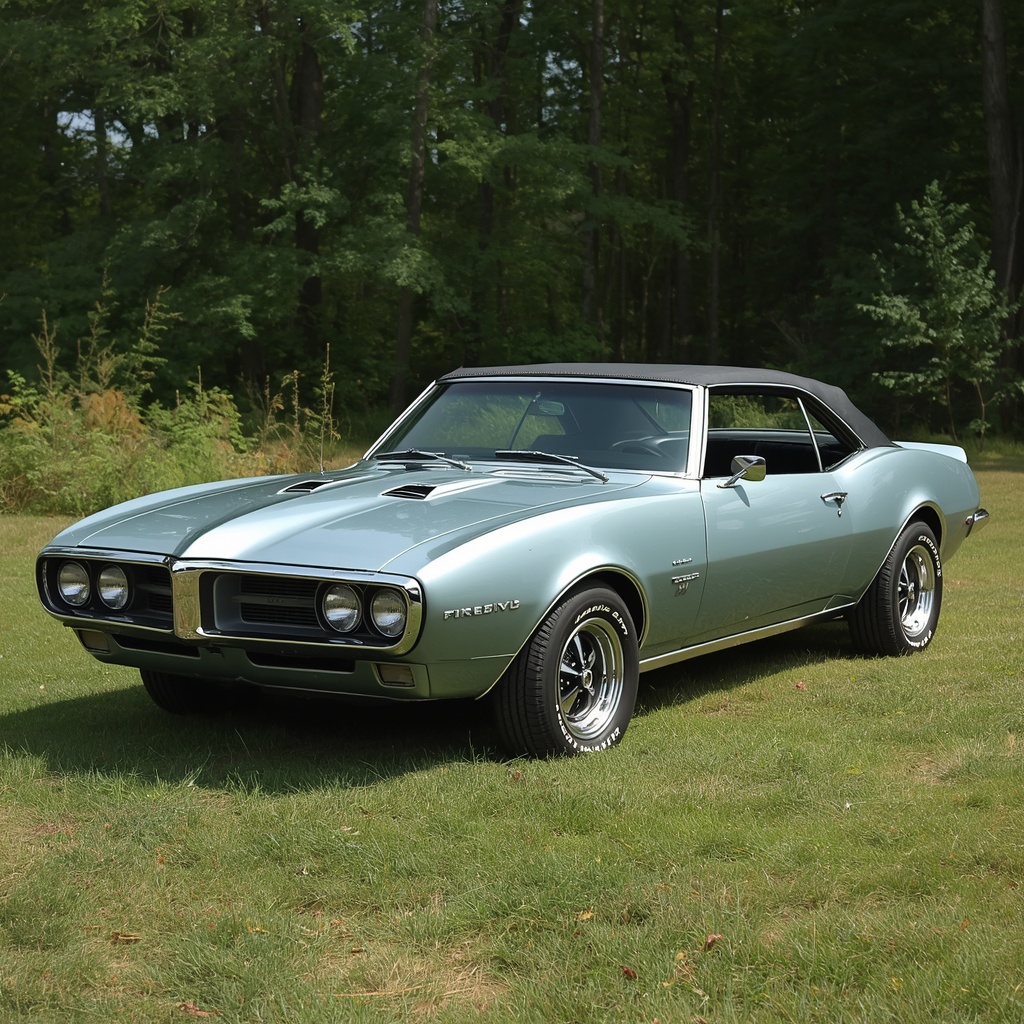
Quick Answer: The spark plug gap 1968 Pontiac Firebird engines call for is 0.035 inches (35 thousandths), the factory setting across the entire lineup that year, including the 250 SOHC inline-six, 350 V8, and 400 V8, since all of them ran the same point-type ignition system. Pontiac didn’t move to High Energy Ignition (HEI) until 1975.
Spark Plug Gap 1968 Pontiac Firebird Specs by Engine
| Engine Option | Displacement | Ignition System | Factory Spark Plug Gap |
|---|---|---|---|
| 250 SOHC inline-6 | 4.1L | Point-type | 0.035″ |
| 350 V8 (base and HO) | 5.7L | Point-type | 0.035″ |
| 400 V8 (including Ram Air) | 6.6L | Point-type | 0.035″ |
Why Every Engine Uses the Same Gap
As with other GM cars of the era, the Firebird’s spark plug gap comes down to the ignition system, not the engine. Every 1968 Firebird, from the base inline-six up through the 400 Ram Air, used a single-point breaker distributor, since Pontiac didn’t adopt HEI until 1975. That’s why 0.035″ was the universal factory tune-up spec across the whole 1968 lineup, and it stayed that way through 1974 for Pontiac’s V8s generally.
A fun bit of trivia while you’re under the hood: the 1968 Firebird’s base six wasn’t a typical pushrod engine. Pontiac’s 250 was an overhead-cam (SOHC) design, a genuinely unusual engineering choice for an American inline-six at the time, and it uses the same 0.035″ gap as the V8s despite the different valvetrain.
If You’ve Upgraded to HEI or Electronic Ignition
Converting to an HEI distributor or an aftermarket electronic ignition is a common upgrade on these cars, and it changes the recommended gap. A stronger, higher-output coil can reliably jump a wider gap, and most HEI or electronic ignition conversions run 0.045″ as a starting point, with some owners going wider depending on the specific coil and compression ratio. If you’re still running the original points setup, stick with 0.035″.
Setting the Gap Correctly
When setting the spark plug gap 1968 Pontiac Firebird engines need, use a wire-type (round-wire) gap gauge rather than a flat feeler gauge for a more accurate reading against the plug’s curved ground electrode. Adjust by bending the ground electrode only, never the center electrode, and recheck the gap any time a plug is dropped.
A Few Real-World Scenarios
- Restoring a numbers-matching 400 Ram Air? Keep it at 0.035″ to stay period-correct with the original points ignition.
- Daily-driving the base 350 with original points? 0.035″ remains correct until the ignition system itself changes.
- Already converted to HEI or an aftermarket electronic setup? Start at 0.045″ and adjust based on how the engine runs.
A gap that’s drifted can also mimic other issues, including your car jerking when accelerating or shaking under acceleration, so it’s worth checking before chasing a bigger problem.
Conclusion
Whether your 1968 Firebird has the base SOHC six or a 400 Ram Air, the factory spark plug gap 1968 Pontiac Firebird engines share is 0.035 inches across the board, since every engine that year shared the same point-type ignition. The only reason to run something different is a genuine ignition upgrade, in which case the new system’s spec, typically 0.045″ for HEI, takes over.
Frequently Asked Questions
Does the spark plug gap change between the 350 and 400 Firebird engines?
No, 0.035″ applies to both, along with the base inline-six, since the gap is set by the point-type ignition system every 1968 Firebird shared, not the engine displacement.
What gap should I use if I’ve converted my Firebird to HEI?
Most HEI or electronic ignition conversions run 0.045″ as a starting point, since the stronger coil can reliably fire a wider gap than the original points system.
Did the 1968 Firebird’s six-cylinder use a different gap than the V8s?
No. Despite its unusual overhead-cam design, Pontiac’s 250 inline-six used the same point-type ignition and the same 0.035″ gap as the 350 and 400 V8s.
What tool should I use to check spark plug gap?
A wire-type (round-wire) gap gauge is more accurate than a flat feeler gauge, since it seats better against the curved ground electrode.
When did Pontiac switch from points to HEI?
Pontiac, like the rest of GM, introduced High Energy Ignition (HEI) starting with the 1975 model year. Every 1968 through 1974 engine used point-type ignition.